The rule
Spend a week in any prop-firm Discord and you will see it drawn on a chart. Mark the high and low of the first fifteen minutes from 9:30 ET. On the first one-minute close outside that range, go with it, no later than 11:30. Both directions. Flat at 15:30 ET by market order — 2:30 Chicago, forty minutes inside Topstep’s 3:10 CT close-out, so nothing here depends on an exit a funded account could not take. No stop, no target, one contract, NQ.
Nothing else. No volume condition, no trend filter, no “only on gap days.” That is the rule as submitted through the wizard on August 21, 2026, declared as version #1 with a seen-from year of 2023. It was scored by the engine, not by a person, and the report it received is the same report a stranger receives.
Readers of this page have said, fairly, that nobody trades a breakout without a stop. Correct — and the no-stop version is still tested first, on purpose. You cannot measure what a stop adds until you know what the signal is worth without one. A stop and a target are a change to the strategy, not a detail, and the engine scores a bracketed version as a second strategy shown beside the first. The bracketed forms of this rule — one-to-one and two-to-one, stop at the far side of the range — were run, and the table is below.
The verdict
28 out of 100. Rejected. Gate G7, era-manufactured edge. Four of six pillars below half credit.
The headline number that sells this rule is real: 4,708 trades since 2008, net +$33,611 after $14.20 per round trip. The number underneath it is the one that matters.
| Era | Years | Trades | Net result |
|---|---|---|---|
| Unseen (2008–2022) | 15 | 3,783 | −$19,979 |
| Seen, as declared (2023–2026) | 3.6 | 925 | +$53,590 |
It lost money for fifteen years and then made all of it, and more, in the years the submitter said he was looking at. That is the G7 signature: unseen expectancy negative, seen expectancy positive and more than three times its size.
Year by year, unseen era
| Year | Net | Year | Net |
|---|---|---|---|
| 2008 | +$8,511 | 2016 | −$10,248 |
| 2009 | −$8,884 | 2017 | −$16,606 |
| 2010 | −$7,758 | 2018 | −$1,992 |
| 2011 | −$5,055 | 2019 | +$6,408 |
| 2012 | −$1,668 | 2020 | −$50,971 |
| 2013 | −$5,053 | 2021 | +$35,684 |
| 2014 | +$2,517 | 2022 | +$51,960 |
| 2015 | −$16,823 |
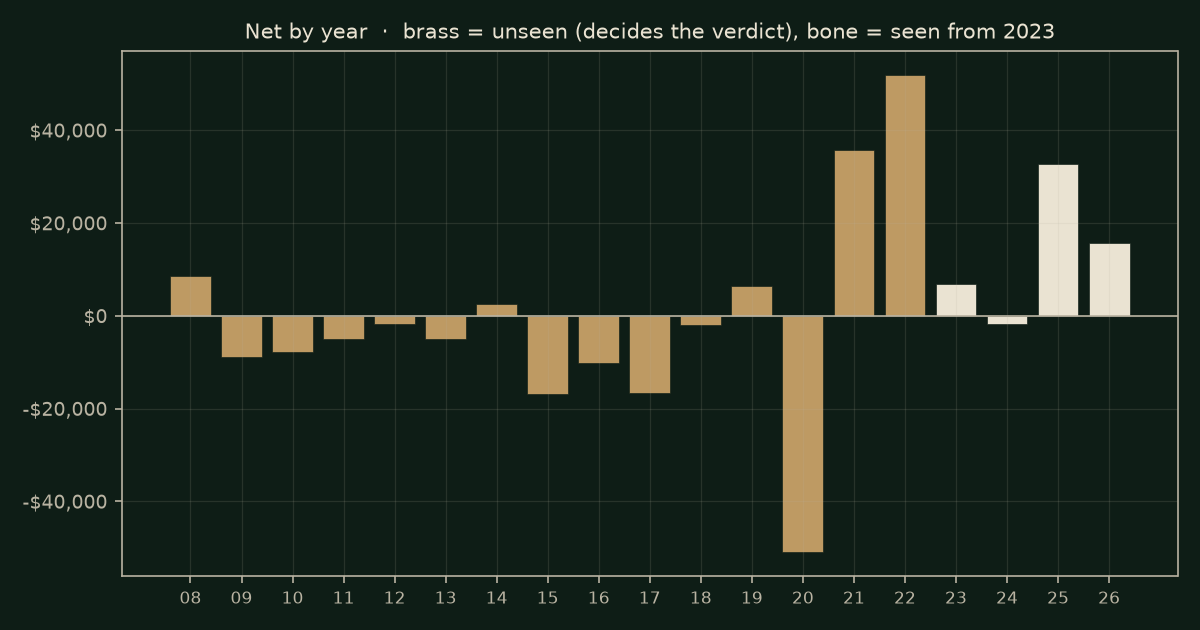
Five of fifteen years positive. 2020, the year everyone remembers as the breakout year, was the worst year this rule ever had. 2021 and 2022 produced $87,644 between them, and that is where the whole story lives. Remove those two years and the unseen era is −$107,623.
Compared to what? The coin-flip test
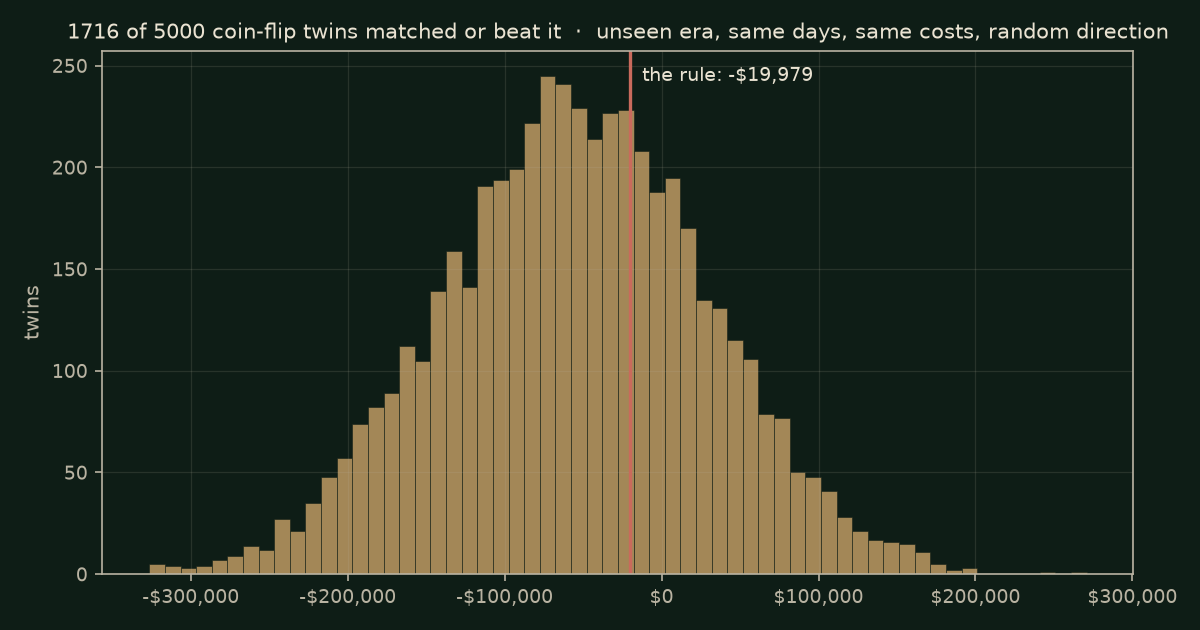
The engine runs five thousand twins. Each twin takes the same trades on the same days with the same costs and flips a coin for direction. If “go with the break” carries information, the rule should beat most of its twins.
Full window: p = 0.23. About one twin in four did as well or better by flipping coins. Unseen era, which governs: p = 0.34. One in three.
Where the money actually went
Net is 33% of gross at one tick per side. Two-thirds of what this rule makes, it hands to the exchange and the spread. At two ticks per side it is −$13,469; at three, −$60,549. Breakeven is 1.7 ticks per side. NQ is quoted one tick wide for most of the day. This rule lives inside the spread.
Concentration: the top trade is 94% of net. One trade. The top five are 243% of net; without them the rule is underwater. A bootstrap of five thousand resampled histories puts the unseen-era net between −$182,000 and +$146,000, with P(net > 0) = 0.41.
Livability
The score says whether the edge is real. This section says whether a person could have held it. No points attach.
| Longest stretch without a new equity high | 185 months (ending June 2024) |
| Rolling 12-month windows that lost money | 61% of 213 |
| Worst 12 months | −$65,801 (ending Feb 2021) |
| Maximum drawdown | $149,706 |
| Median year | −$1,751 |
| Years of median to recoup the drawdown | n/a — the typical year recoups nothing |
| Share of all profit from the best two years | 261% |
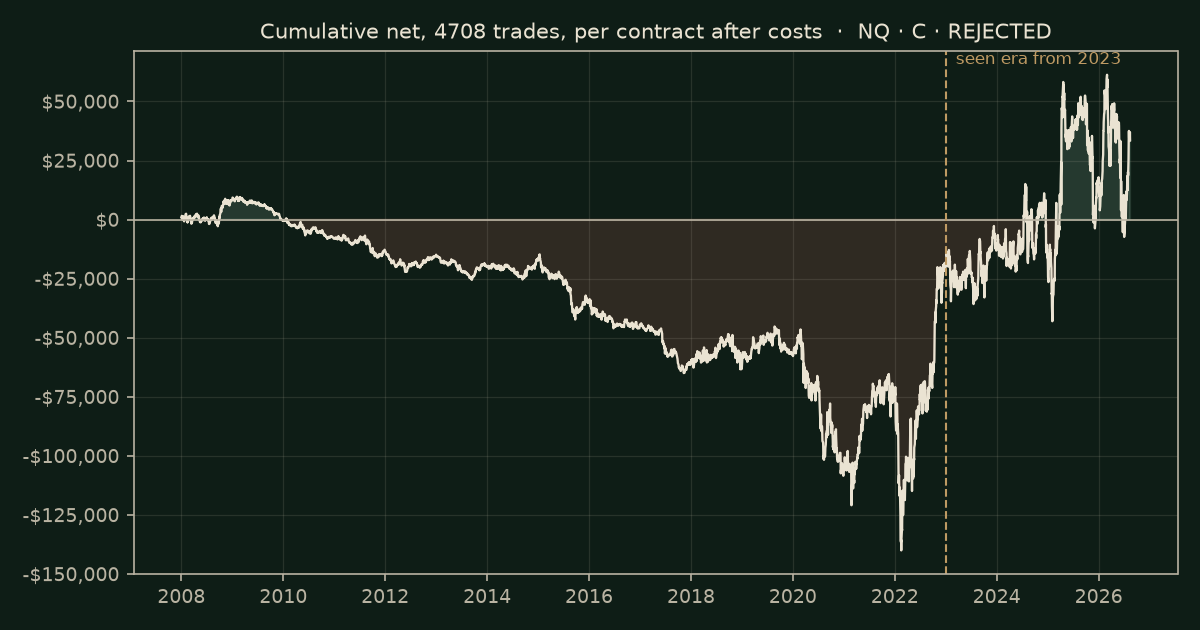
Nobody holds a rule through fifteen and a half years of new lows. The only way to have collected the 2021–22 money was to have started in 2021, and the only way to have started in 2021 was to have looked at 2021 first.
What passed
Parameter sensitivity scored 15 of 15. Move the range length or the entry cutoff ten percent in either direction and the result is the same. That deserves to be said plainly: this rule is not fragile. It is robustly nothing. Stable parameters around a coin flip are still a coin flip.
Verdict
REJECTED — 28/100. Gate G7 tripped: the rule’s edge exists only in the era its submitter declared as seen. The data was clean (6,180,656 bars, zero anomalies), the fills were honest (next-bar-open market orders, one tick adverse per side), and the result reproduces from the rule text above. The evidence is valid. It says no.
Reproducibility
Anyone with NQ 1-minute data for 2008–2026 and the rule as written above should land within Protocol tolerance (±10%) of 4,708 trades and +$33,611 net at $4.20 commission and one tick per side. The full engine report, number 9e1416fc6a, is on file and available on request. If you run it and land materially elsewhere, we want to hear about it.
Questions people ask
Does the opening range breakout work on NQ? Over the full 18 years, 4,708 trades made $33,611 after costs, and all of it came from 2023 on. The fifteen years before that lost $19,979, with 5 of 15 years positive. It is rejected on gate G7: an edge manufactured by the recent era.
How does it compare to a coin flip? 34% of 5,000 random-direction twins, taking the same days at the same costs, did as well or better. A rule with an edge should leave almost none of them ahead of it.
What does slippage do to it? The result reaches zero at 1.7 ticks per side. At two ticks of slippage a side, which is ordinary on a fast open, it loses money.
Does it work better on some days of the week? Yes, and the split is the whole story: Fridays alone made $141,740 over 18 years and Wednesdays lost $108,292. The Friday-only version is Teardown No. 5.
Methods honesty — the correction ledger
Published as standard practice:
- This page was built from the engine’s own report, not from a human re-run. The Protocol version was v1.1 in draft when this page went up (signed August 22, 2026); two rubric corrections found by running this very rule (efficiency credit on a losing unseen era; the 100-unseen-trade minimum) were applied before the 28 was printed. An earlier draft of the rubric had printed 36.
- The engine report’s section 1 prints the locked rule twice (wizard block and engine block). Cosmetic; logged.
What this cannot tell you
The score assumes this rule walked in once, and that the submitter’s development did not touch 2008–2022. Neither was sworn. If you trade a version with a filter on it, submit it: a filter is scored as a second strategy and the report shows base and filtered side by side. If you want your search history under testimony, that is what an audit is.
What readers asked for, and what it did
Three requests came in on the public thread. Each was run on the rule above, same data, same costs, same engine, reconciled to this page’s 4,708 trades and +$33,611 before anything was posted. Unseen p is the share of 5,000 coin-flip twins that matched or beat the rule on 2008–2022.
| Exit | Trades | Net, full | Net, unseen | Unseen p | Win |
|---|---|---|---|---|---|
| No stop, flat 15:30 ET (this page) | 4,708 | +$33,611 | −$19,979 | 0.343 | 49.7% |
| Stop one range-width away, no target | 4,708 | +$154,946 | +$16,396 | 0.406 | 39.0% |
| Same stop, target 1R | 4,708 | +$13,841 | −$73,404 | 0.683 | 49.4% |
| Same stop, target 2R | 4,708 | +$142,921 | +$12,346 | 0.421 | 41.3% |
| 25-point stop, 50-point target | 4,708 | −$40,414 | −$35,909 | 0.388 | 41.0% |
A stop makes the money bigger and the edge smaller. Stop-only is the best number in the study, and its unseen p is worse than no stop at all, because the coin-flip twins got the same stop and it cut their losers too. A wide stop in a market that went up for fifteen years helps everyone; it does not make the entry smarter. The 1:1 target is the destroyer it always is.
| Filter | Trades | Net, full | Net, unseen | Unseen p |
|---|---|---|---|---|
| All days (this page) | 4,708 | +$33,611 | −$19,979 | 0.343 |
| Longs only | 2,421 | +$103,622 | +$16,225 | 0.229 |
| Shorts only | 2,287 | −$70,010 | −$36,204 | 0.555 |
| Skip FOMC statement days (154, verified against federalreserve.gov) | 4,558 | +$73,171 | −$7,021 | 0.307 |
| Skip Mondays and Fridays | 2,847 | −$120,042 | −$99,418 | 0.833 |
| Skip Mon, Fri, and FOMC | 2,699 | −$86,391 | −$92,369 | 0.823 |
The plain rule is a long rule, which in a market that went from 2,000 to 25,000 is not a discovery, and neither side alone beats the twins. Skipping FOMC days was the one filter that helped the money: those 150 days lost $39,560 on their own. It moved p by three hundredths. Every one of these cuts is one more look at the same data, and the lineage on any page built from them would say so.
Where the money was
The era is the rule: the seen years carry all of $33,611.40; the unseen years made -$19,978.60. Longest wait for a new equity high: 185 months, median year -$1,751.00.
No next run is pointed at: no change fixes an era; the rule as written is the seen years' rule.
If you trade this by eye
Against 5,000 coin flips the written rule is a coin (1716 of 5,000 matched or beat it on the unseen years); whatever you do on top of the written steps is where any edge is, and your fills are how to find out which part.
Everything this rule made, it made in the years you learned it in; the fifteen before them say the written rule is a coin, and whatever you do on top of it is where any edge is.
That is what the record says about the rule as written. It is not what next year says.
A course, a bot, a signal room, or an evaluation you’d trade it in: the same test that made this page runs on the rule as the seller states it, for $49, before the card goes through. Read this before you pay →
The standing challenge
Convinced your variant survives? Once a month we take one reader-submitted variant of a previously torn-down rule and test it free, under a frozen specification, and publish the result either way. Email audits@thinridge.io with the subject line “Standing challenge” and the exact rule. Or submit it yourself at thinridge.io; a report is $49.