The rule
On one-minute NQ, between 10:00 and 11:00 ET: three consecutive bars where the first bar’s high sits below the third bar’s low leave a band of prices the middle bar jumped over — a fair-value gap, bullish. The mirror, first bar’s low above the third bar’s high, is bearish. The band must be at least two points wide and the third bar must close inside the window. The first later bar to close back inside the band, also inside the window, is the signal; the trade goes in at the next bar’s open, long on a bullish gap, short on a bearish one. A bar that closes clean through the far edge of the band before that voids the setup for the day. First qualifying gap of the day only, one trade a day. No stop, no target: market out sixty minutes after the signal. One contract, $4.20 round-turn commission and one tick per side of slippage, same as every run this engine does.
Submitted through the public wizard on September 5, 2026, declared version #1. Nobody sent this one in; it is the examiner’s own submission, chosen because it is searched for more than any rule we have tested and stated less. Four choices had to be made to turn the setup into a rule, and every one of them is in the paragraph above; a different set of choices is a different rule, and the standing challenge at the bottom of this page is where a different set goes.
Where it came from
“Silver Bullet” is the name a widely followed teacher of price-action concepts gave to a fair-value-gap entry taken inside one of three fixed hours of the trading day. The ten-to-eleven window is the one most people mean when they say it. As taught, it comes wrapped in judgment: which gap counts, whether liquidity was taken first, where the “draw” is that the trade aims for. As tested here, it is the skeleton — the hour, the gap, the return to the gap — with the judgment replaced by the four declared choices and the exit replaced by a clock. That is not a hostile reading. It is the only reading a machine can score, and the only one anybody else could reproduce.
One choice deserves its own sentence, because it is where a real trader’s fills would differ from these. Many people trade this setup with a resting order at the edge of the gap. This engine fills at the open of the bar after a close inside the band, which is later and usually worse. If the setup has an edge that lives in the first tick of the retrace, this page will understate it; the bracket run below is the place to look for that, and it does not show one.
The verdict
13 out of 100. Rejected. Five of the six pillars below fifty percent: out-of-sample, walk-forward, Monte Carlo, cost stress and sensitivity. Only data integrity passed, because the data is not the rule’s fault. No gate tripped; a gate is for a rule that scored well enough to need one.
Over the full eighteen and a half years the rule lost $22,272 on 2,372 trades, about $9 a trade. It made money in the seen era — every year from 2023 onward, $47,883 in total — and lost $70,155 in the fifteen years before, which is the era that decides the verdict, because those are the years nobody could have tuned to. Win rate 47.6%.
What the bracket did
Nobody trades a fair-value gap with a sixty-minute clock and no stop, so the second column is the rule as people actually run it: a ten-point stop from the fill and a target at twice the stop distance, clock kept as the backstop. Same 2,372 entries, same costs.
| Rule as stated (scored) | 10-point stop, 2R target | |
|---|---|---|
| Trades | 2,372 | 2,372 |
| Net, full window | −$22,272 | −$45,767 |
| Seen era net (2023–2026) | +$47,883 | −$9,747 |
| Unseen era net (2008–2022) | −$70,155 | −$36,020 |
| Unseen-era p vs. coin flips | 0.9256 | 0.8796 |
| Win rate | 47.6% | 36.8% |
| How the trades ended | 2,372 on the clock | 1,226 stopped · 453 at target · 674 on the clock · 19 both in one bar |
| Score | 13 · Rejected | 11 · Rejected |
The stop does what stops do: it cuts the unseen-era loss roughly in half. It also does the other thing stops do, and here it is the whole story. The seen era, the only stretch where this rule ever made money, goes from +$47,883 to −$9,747. The years since 2023, the only ones in which this rule ever made money, were made by sitting through moves a ten-point stop does not survive. Trade it the way it is drawn and its only good years stop working.
Year by year, unseen era
| Year | Net | Year | Net |
|---|---|---|---|
| 2008 | −$4,413 | 2016 | −$3,000 |
| 2009 | +$91 | 2017 | −$5,139 |
| 2010 | −$727 | 2018 | −$3,311 |
| 2011 | −$3,686 | 2019 | −$2,849 |
| 2012 | −$4,659 | 2020 | −$6,709 |
| 2013 | −$931 | 2021 | −$6,075 |
| 2014 | −$4,620 | 2022 | −$18,733 |
| 2015 | −$5,395 |
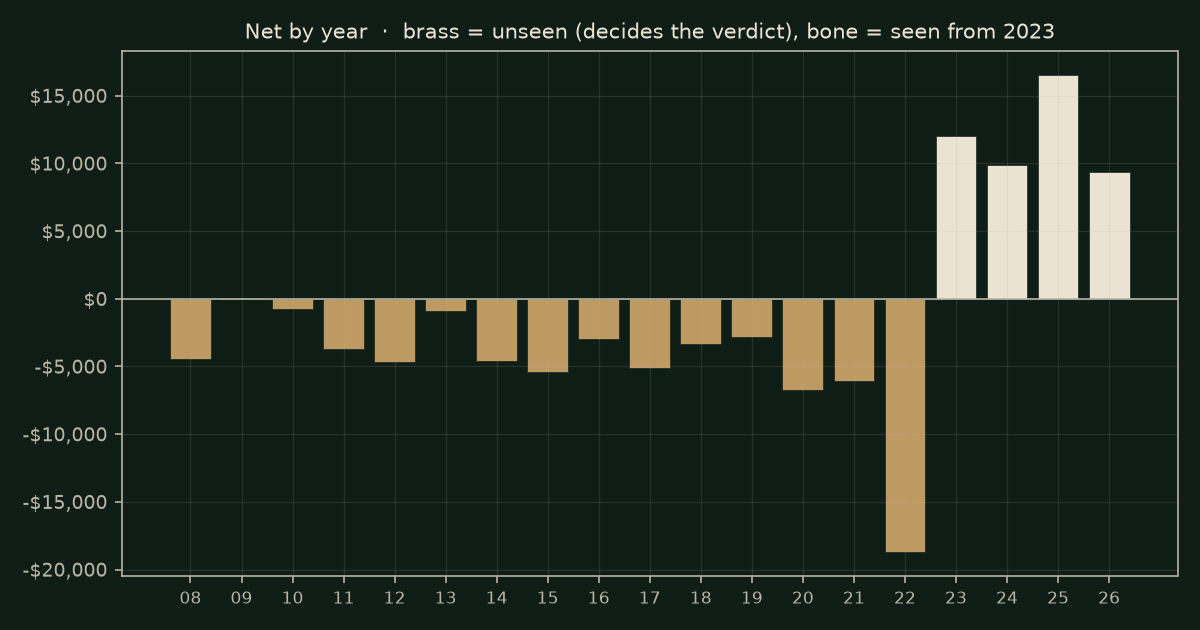
One of fifteen unseen years positive, and that one by $91. Walk-forward efficiency 0.70. Then 2023 arrives and every bar turns bone. If a rule’s entire profit sits inside the years declared as seen, the exam has to ask whether the rule made the years or the years made the rule, and fifteen brass bars answer that question before the coin flips do.
Compared to what? The coin-flip test
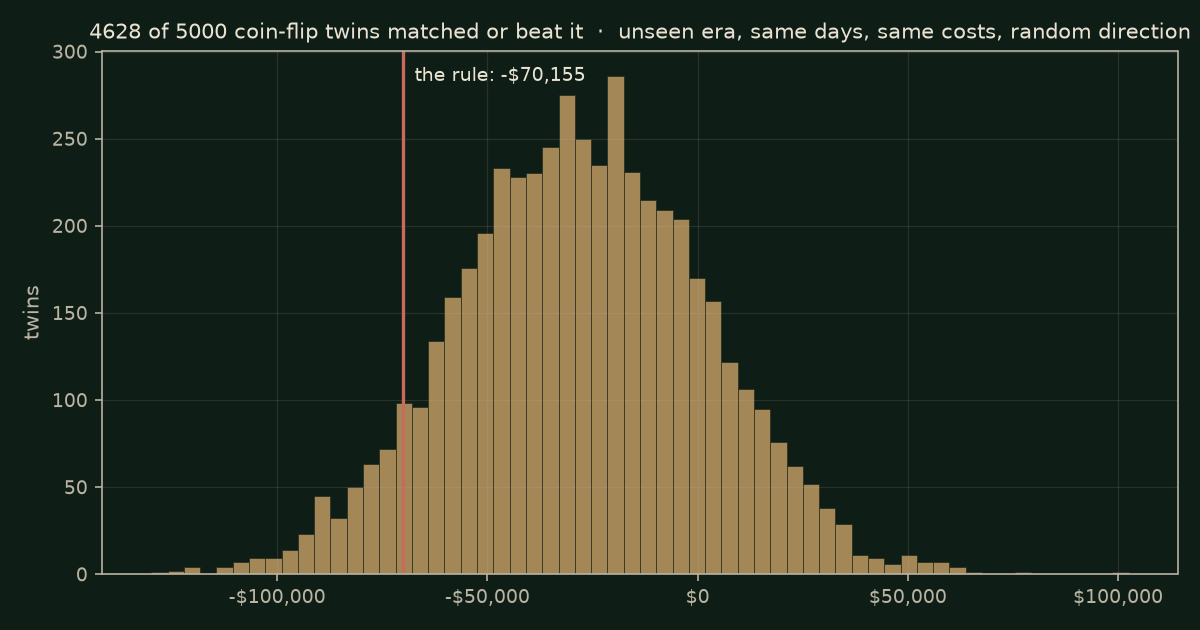
Five thousand twins, same days, same costs, coin-flip direction. Full window: p = 0.3948 — 1,974 of 5,000 twins matched or beat the rule, about what a coin does. Unseen era, which governs: p = 0.9256 — 4,628 of 5,000. Read that as the sentence it is: on the fifteen years before 2023, choosing long or short by coin flip at the same moments beat the rule ninety-three times in a hundred. There is directional information in these entries. It points the wrong way.
Costs
Before costs the rule made about $11,400 over eighteen years. The toll on 2,372 round trips at $14.20 each is $33,682, so net is −195% of gross: the rule pays nearly twice what it earns to the exchange and the spread. Two ticks of slippage instead of one: −$45,992. Three: −$69,712. Breakeven friction is zero ticks per side, meaning there is no fill quality at which this comes out ahead. Profit factor at double friction 0.92.
Sensitivity
Plateau retention 0%. Sign flip: yes — move the gap size ten percent either way and the sign of the full-window result changes. Four parameters. A result that changes sign when you nudge its one real setting is not a result; it is a coordinate.
Livability
The score says whether the edge is real. This section says whether a person could have held it. No points attach.
| Longest stretch without a new equity high | 224 months (ending August 2026 — the entire history) |
| Rolling 12-month windows that lost money | 75% of 213 |
| Worst 12 months | −$28,595 (ending April 2023) |
| Maximum drawdown | $77,616 |
| Median year | −$3,311 |
| Years of median performance to recoup the drawdown | n/a — the median year loses |
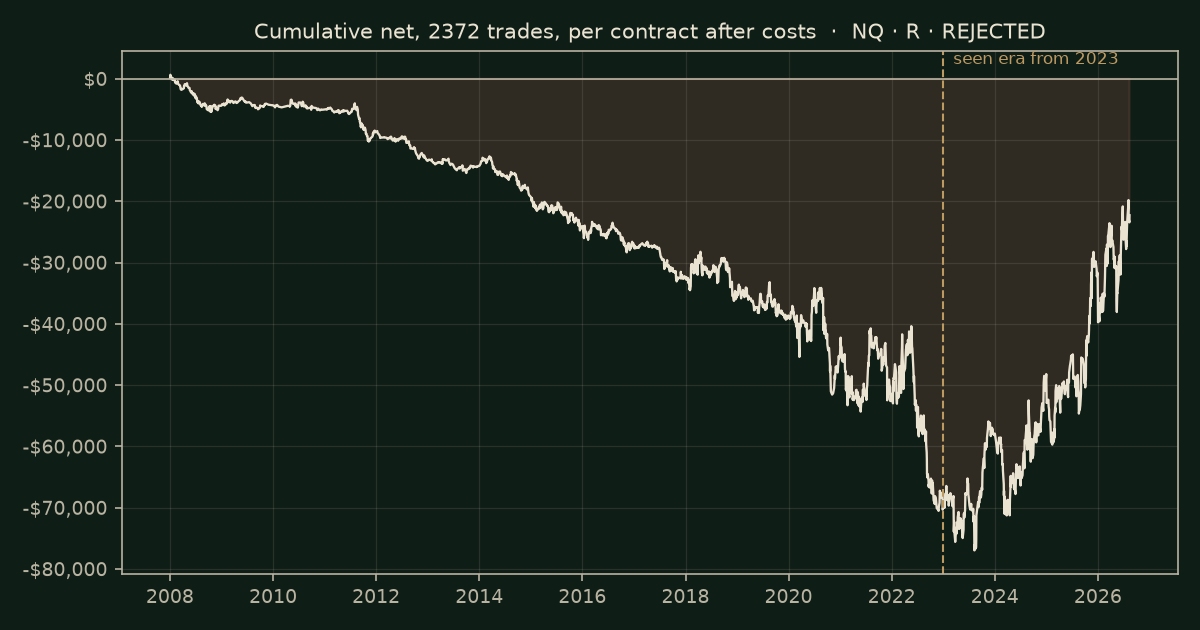
A person who started trading this in January 2008 has never once been above where they began. The worst twelve months ended in April 2023, four months into the era that made it famous. The recovery since is real on the chart and real in the seen-era column, and it is still $22,000 short of zero. On a funded account it is unrunnable; in a personal account it is eighteen years of paying to find out.
Verdict
REJECTED — 13/100. Code not offered. The data was clean (6,180,656 bars, zero anomalies), the fills honest, the four choices declared, and the result reproduces from the rule text above — twice, on two machines, to the cent. The entries carry no directional information that survives the years nobody could have tuned to; a coin at the same moments does better. What the rule has is the years since 2023, and those years disappear the moment it is traded with the stop it is always drawn with. That is the finding, and it is the same finding as Teardown No. 2 in a different costume: a rule whose only good years are its most recent ones.
Reproducibility
Anyone with NQ 1-minute data for 2008–2026 and the rule as written above should land within Protocol tolerance (±10%) of 2,372 trades and −$22,272 net at $4.20 commission and one tick per side. The full engine report, number d8d1ad619e, is on file, as is the bracket run beside it. If you run it and land materially elsewhere, we want to hear about it.
Questions people ask
Does the ICT Silver Bullet work? Stated as a rule and run on 18 years of 1-minute NQ: 2,372 trades, 14 of the 15 unseen years lost, $70,155 lost on those years, and 4,628 of 5,000 coin-flip twins did as well or better. Every year since 2023 was up, which is the era everyone learned it in.
What about a 10-point stop and a 2R target? Worse. The bracket most people trade it with cut the losses on the bad years by about half and turned the good years negative: −$45,767 over the full window, 36.8% winners. Whatever it made since 2023 it made by sitting through moves a 10-point stop cannot sit through.
How was a discretionary setup written as a rule? Four choices, each declared before the run: the 10:00 to 11:00 ET window, a three-bar gap of at least two points, entry on the first close back inside the gap at the next bar's open, and out after sixty minutes. The page lists them so anyone can argue with one.
Methods honesty — the correction ledger
- This rule is the examiner’s statement of a discretionary setup, not a transcription of anyone’s. The four choices — the three-bar gap definition, the two-point minimum, entry on a close inside the band rather than a resting order at its edge, and first-gap-then-void — are ours, named above. A reader who trades it with a liquidity sweep required first, or a structure stop, is trading a different rule, and can submit it.
- The public door counted this as the second look at the rule, because the same email had one earlier submission on record — a different rule, the founder’s own August self-test. By the Protocol’s definition a look at a different rule is not a look at this one, so the honest lineage is #1 and the unseen p stands at 0.9256; at the door’s #2 it is 0.9945. The verdict is the same at either number. The counting is being corrected to per rule, and this page records that it was not yet.
- Before the run the examiner registered: 1,500 to 3,500 trades (hit, 2,372); rejected on the unseen era (hit); and a trade count skewed toward recent years because the two-point minimum is stated in points on a contract that has risen tenfold (miss — about 130 qualifying days a year in each era). The wizard’s explanation of the gap setting said the same wrong thing and was corrected before this page went up.
- The same rule was run on the founder’s machine and through the public door within the hour. Every line of the two reports agreed to the cent, including all fifteen unseen years and both bootstrap intervals. Two code paths, one engine, one answer.
What this cannot tell you
Whether the Silver Bullet as taught — with the sweep, the draw, and the judgment about which gap is the right one — does better than its skeleton. The exam only knows what can be written down, and this is what can be written down. It also cannot tell you the seen era is over: 2023 through 2026 were real profits at this rule’s clock exit, and a period that began in 2023 may continue. What it can say is that a rule whose profit is entirely inside its most recent years, and whose profit vanishes under the stop it is always drawn with, has not yet shown anything a coin could not. Popular and tested are different words. This page is the second one.
Where the money was
The numbers are a spike: a 10% nudge either way keeps 0% of the result. Longest wait for a new equity high: 224 months, median year -$3,310.60.
The one next run, if a reader wants it: the neighboring setting of the primary trigger (10%% either way), as lineage #2. Prediction on file: a plateau under 25%% means the neighbor rejects too; this run is to show it. Three such runs at most, then the verdict stands.
If you trade this by eye
Against 5,000 coin flips the written rule is a coin (4628 of 5,000 matched or beat it on the unseen years); whatever you do on top of the written steps is where any edge is, and your fills are how to find out which part.
That is what the record says about the rule as written. It is not what next year says.
A course, a bot, a signal room, or an evaluation you’d trade it in: the same test that made this page runs on the rule as the seller states it, for $49, before the card goes through. Read this before you pay →
The standing challenge
Once a month we take one reader-submitted variant of a published rule, test it free under a frozen specification, and publish the result either way. If you trade a version of this one with a condition the skeleton lacks — a sweep of the prior high or low before the gap forms, a gap on five-minute bars, a stop at the far edge of the three-bar structure — write it down in numbers and submit it at thinridge.io. A condition is scored as one more look and shown beside the base, and it will be held to the same standard this one was.